Powering Investment Intelligence: A Deep Dive into Advanced Graph RAG with Neo4j, LLMs, and Vector Search
May 26, 2025
14 min read
Saumil Srivastava
Engineering Leader
Table Of Contents
Loading content outline...
Introduction: Why Graph RAG for Investment Intelligence?
In today's data-driven financial landscape, deriving actionable intelligence requires moving beyond siloed datasets and simple keyword searches. Investment professionals need to answer complex, multi-faceted questions that often depend on understanding the intricate relationships between companies, market events, financial instruments, and news sentiment. This is where Retrieval Augmented Generation (RAG), supercharged by Knowledge Graphs (KGs), offers a transformative approach.
The Power of Graph RAG
Powering Investment Intelligence: A Deep Dive into Advanced Graph RAG with Neo4j, LLMs, and Vector Search | Saumil Srivastava's Blog
A Knowledge Graph represents data as a network of entities (e.g., companies, investors, news articles) and the rich relationships connecting them. When combined with Large Language Models (LLMs), this "Graph RAG" architecture enables:
Answering Complex, Multi-Hop Questions: Traversing multiple layers of relationships to uncover non-obvious connections
Integrating Diverse Data Types: Seamlessly linking structured financial data (like P/E ratios) with unstructured text (news articles, company summaries)
Enhanced LLM Context: Providing LLMs with precise, relevant, and interconnected information, leading to more accurate and insightful answers than traditional vector RAG alone
Explainable AI: The graph structure makes it easier to trace the "reasoning" path of an AI system
Technical Challenges We'll Address
This post provides a technical walkthrough of building an "Investment Intelligence KG" using Neo4j, enriching it with OpenAI LLMs, and implementing advanced Graph RAG techniques. We'll tackle:
Consolidating siloed financial data into a connected KG
Formulating and executing multi-hop queries that span different entities and relationships
Leveraging LLMs for data enrichment (sentiment analysis, summarization) and natural language understanding (Text2Cypher)
Implementing semantic search capabilities directly on the graph data
Strategically choosing the right retrieval mechanism for a given query
System Architecture: Building an Investment Intelligence Graph RAG
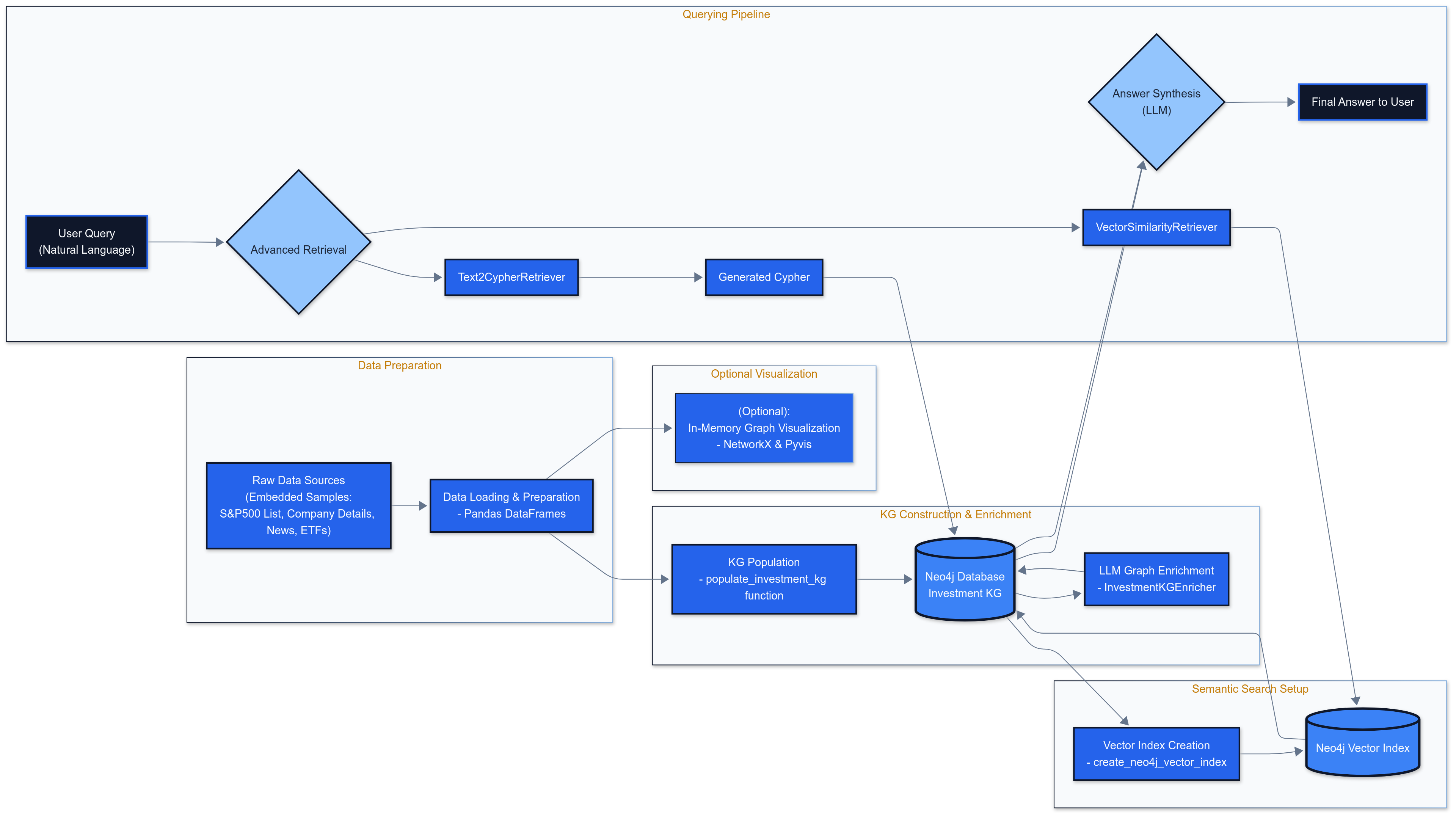
The system involves several key stages, from data ingestion to sophisticated query processing.
Description: This diagram illustrate the end-to-end flow:
Data Sources (e.g., yfinance, news APIs, company filings, ETF data providers)
ETL (Extract, Transform, Load) pipeline populating the Neo4j Knowledge Graph
LLM Enrichment (sentiment, summaries) module interacting with the KG
Neo4j Vector Index creation and updating
User Query Interface
(Conceptual) Query Router
Text2Cypher Retriever and Vector Similarity Retriever modules
LLM for final answer synthesis from retrieved context
User receiving the answer
Building the Investment Knowledge Graph in Neo4j
Schema Definition
Our Investment KG comprises the following entities and relationships:
*\*Entity\**: A generic label for all primary entities to allow unified vector indexing
Relationships
`(Company)-[:OPERATES_IN_SECTOR]->(Sector)`
`(Company)-[:OPERATES_IN_INDUSTRY]->(Industry)`
`(Company)-[:MENTIONED_IN_NEWS]->(NewsArticle)`
`(ETF)-[:HOLDS_STOCK]->(Company)`
`(Investor)-[:INVESTED_IN]->(Company)` with `stage` property
`(ETF)-[:FOCUSES_ON_ASSET_CLASS]->(AssetClass)`
Implementation: Constraints and Data Population
Unique constraints are crucial for data integrity and query performance:
1defcreate_investment_kg_constraints_updated(driver):2"""Creates unique constraints on node properties."""3ifnot driver:4 logging.error("Neo4j driver not available. Skipping constraint creation.")5return67try:8with driver.session(database="neo4j")as session:9 constraints =[10"CREATE CONSTRAINT IF NOT EXISTS FOR (c:Company) REQUIRE c.ticker IS UNIQUE",11"CREATE CONSTRAINT IF NOT EXISTS FOR (e:ETF) REQUIRE e.ticker IS UNIQUE",12"CREATE CONSTRAINT IF NOT EXISTS FOR (n:NewsArticle) REQUIRE n.link IS UNIQUE",13"CREATE CONSTRAINT IF NOT EXISTS FOR (sec:Sector) REQUIRE sec.name IS UNIQUE",14"CREATE CONSTRAINT IF NOT EXISTS FOR (ind:Industry) REQUIRE ind.name IS UNIQUE",15"CREATE CONSTRAINT IF NOT EXISTS FOR (ac:AssetClass) REQUIRE ac.name IS UNIQUE",16"CREATE CONSTRAINT IF NOT EXISTS FOR (inv:Investor) REQUIRE inv.investorId IS UNIQUE",17"CREATE CONSTRAINT IF NOT EXISTS FOR (ent:__Entity__) REQUIRE ent.name IS UNIQUE"18]19for constraint in constraints:20 session.run(constraint)21 logging.info("✅ Investment KG constraints created/ensured.")22except Exception as e:23 logging.error(f"🛑 Error creating Investment KG constraints: {e}")24
Example Cypher for populating the graph:
1// For Company2MERGE(c:Company{ticker:$props.ticker})3SET c =$props4WITH c
5CALL apoc.create.addLabels(c,['__Entity__'])YIELDnode6SETnode.name =$props.ticker
7RETURNdistinct'company_done';89// For Sector and relationship10MERGE(s:Sector{name:$sector_name})11ONCREATESET s.name =$sector_name12WITH s
13CALL apoc.create.addLabels(s,['__Entity__'])YIELDnodeAS sector_node
14MATCH(c:Company{ticker:$company_ticker})15MERGE(c)-[:OPERATES_IN_SECTOR]->(sector_node);16
Note: The `apoc.create.addLabels` procedure requires the APOC library in Neo4j.
LLM-Powered Graph Enrichment
Raw structured data is valuable, but we can enhance our KG significantly using LLMs to infer new insights.
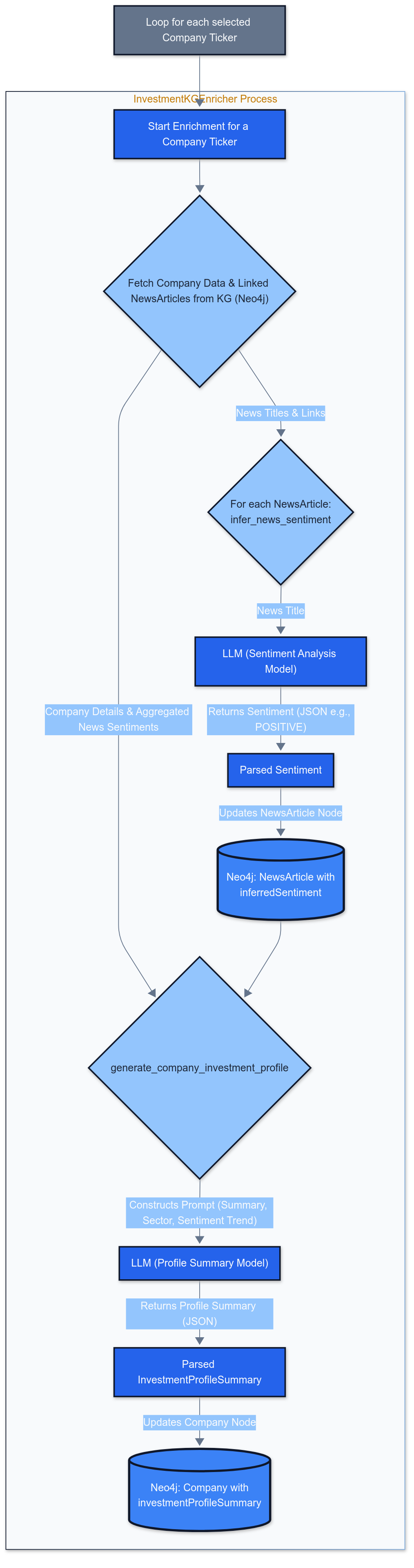
Description: This diagram shows:
Data is read from a Company node and its related NewsArticle nodes in Neo4j
This data is fed into an LLM (OpenAI GPT model)
The LLM performs tasks like sentiment analysis or generates investmentProfileSummary
Results are written back as properties on the respective nodes
Sentiment Analysis Implementation
For each NewsArticle, an LLM classifies the headline's sentiment:
1definfer_news_sentiment(self, news_article_link:str, news_title:str)-> Optional[str]:2 prompt_messages =[3{4"role":"system",5"content":"You are a financial news sentiment analyzer. Classify the sentiment of the given news headline as POSITIVE, NEGATIVE, or NEUTRAL. Return ONLY a JSON object with a single key 'sentiment' and one of these three values."6},7{8"role":"user",9"content":f"News Headline: \"{news_title}\"\n\nJSON:"10}11]1213 llm_response = self._get_llm_response(prompt_messages)1415if llm_response and"sentiment"in llm_response:16 sentiment = llm_response["sentiment"].upper()17if sentiment notin["POSITIVE","NEGATIVE","NEUTRAL"]:18 sentiment ="NEUTRAL"1920# Update Neo4j21with self.driver.session(database="neo4j")as session:22 session.run("""
23 MATCH (n:NewsArticle {link: $link})
24 SET n.inferredSentiment = $sentiment
25 """, link=news_article_link, sentiment=sentiment)2627 logging.info(f"Updated sentiment for news '{news_title[:50]}...' to {sentiment}.")28return sentiment
2930returnNone31
Investment Profile Generation
The LLM considers company data, sector, industry, and aggregated news sentiment to create concise profiles:
1defgenerate_company_investment_profile(self, company_ticker:str)-> Optional[str]:2# Fetch company data from Neo4j3# ... (query implementation)45 prompt_messages =[6{7"role":"system",8"content":"You are a financial analyst providing concise investment profile summaries. Based on the provided company information and recent news sentiment, generate a 1-2 sentence 'investmentProfileSummary'. Focus on key characteristics, market position, or potential outlook. Output ONLY a JSON object with a single key 'investmentProfileSummary'."9},10{11"role":"user",12"content":f"""
13Company Name: {company_name}14Sector: {sector}15Industry: {industry}16Existing Summary: {yfinance_summary[:1000]}17Recent News Sentiment Trend: {overall_sentiment_hint}1819JSON:
20 """21}22]2324# Process and update Neo4j with the generated profile25# ... (implementation continues)26
Vector Indexing for Semantic Search
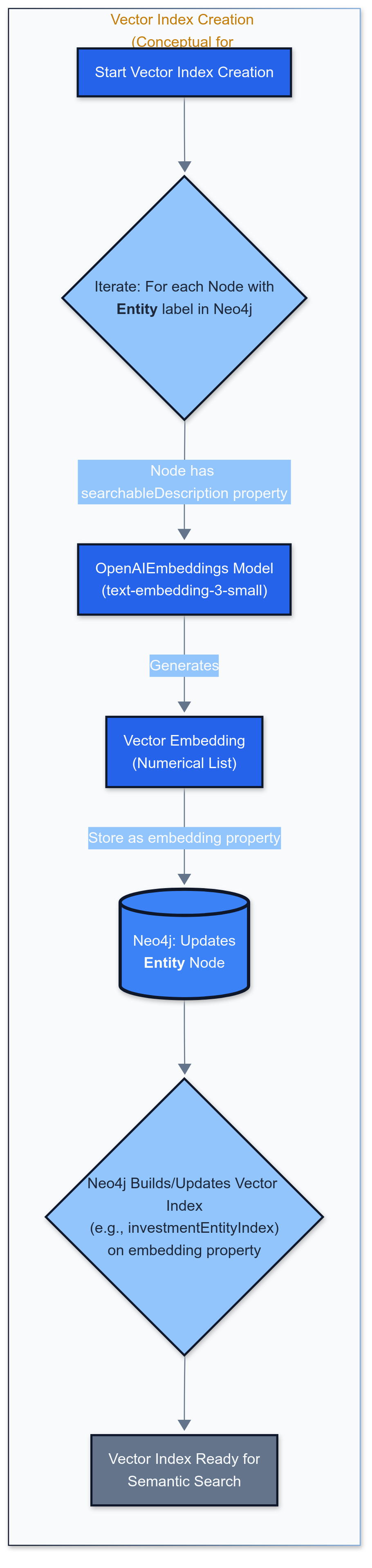
To enable querying based on conceptual meaning rather than just keywords, we implement vector indexing using OpenAI embeddings.
Creating the Vector Index
1from langchain_openai import OpenAIEmbeddings
2from langchain_community.vectorstores import Neo4jVector
34defcreate_neo4j_vector_index(driver, openai_api_key_for_lc, neo4j_uri, neo4j_username, neo4j_password):5 embedding_node_property ='embedding'6 index_name ='investmentEntityIndex'78# 1. Consolidate text into 'searchableDescription'9# Example for Company nodes:10# MATCH (c:Company)11# WHERE c.summary IS NOT NULL OR c.investmentProfileSummary IS NOT NULL12# SET c.searchableDescription = coalesce(c.name, "") + " | Industry: " +13# coalesce(c.industry, "") + ". Summary: " +14# coalesce(c.investmentProfileSummary, coalesce(c.summary, ""))1516# 2. Create/Retrieve Vector Index17try:18ifnot os.getenv("OPENAI_API_KEY"):19 os.environ["OPENAI_API_KEY"]= openai_api_key_for_lc
2021 embeddings = OpenAIEmbeddings(model="text-embedding-3-small")22 vector_store = Neo4jVector.from_existing_graph(23 embedding=embeddings,24 url=neo4j_uri,25 username=neo4j_username,26 password=neo4j_password,27 index_name=index_name,28 node_label="__Entity__",29 text_node_properties=["searchableDescription"],30 embedding_node_property=embedding_node_property,31 database="neo4j"32)33 logging.info(f"✅ Vector index '{index_name}' created/retrieved successfully.")34return vector_store
35except Exception as e:36 logging.error(f"🛑 Failed to create/retrieve Neo4jVector index: {e}")37returnNone38
Advanced Retrieval Strategies
With the enriched KG and vector index, we can implement two powerful retrieval methods.
Text2Cypher Retriever
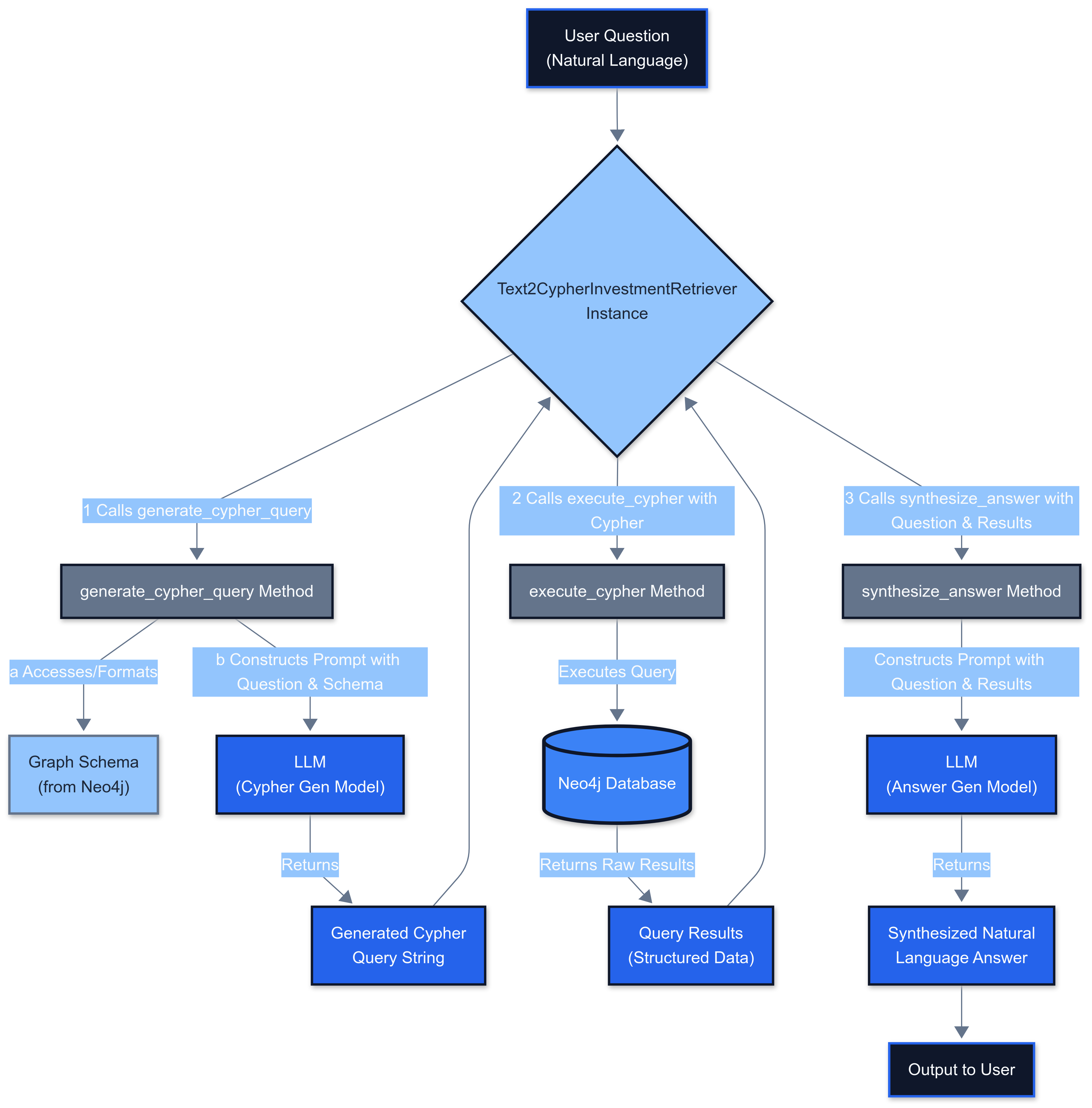
This retriever uses an LLM to translate natural language questions into Cypher queries.
Description: This diagram shows vector similarity retriever
Core Components:
Schema Fetching: Provides the Neo4j schema as context to the LLM
Cypher Generation: Uses GPT-4 to generate precise Cypher queries
Query Execution: Runs the generated Cypher against Neo4j
Answer Synthesis: Processes results into natural language
Implementation Example:
1defgenerate_cypher_query(self, question:str)->str:2 system_prompt =f"""You are an expert Neo4j Cypher query writer...
3 Schema:
4{self.schema}56 Guidelines:
7 - Company nodes identified by 'ticker'
8 - ETF nodes identified by 'ticker'
9 - Relationships: OPERATES_IN_SECTOR, HOLDS_STOCK, INVESTED_IN (with 'stage' property)
10 - Use case-insensitive matching: toLower(node.property) CONTAINS toLower('search_term')
11 - For "latest news", ORDER BY n.publishTime DESC LIMIT 3
12 - Output ONLY the Cypher query
13 """1415 prompt_messages =[16{"role":"system","content": system_prompt},17{"role":"user","content":f"Natural language question: \"{question}\"\n\nCypher Query:"}18]1920# Generate Cypher using LLM21# ... (implementation)22
Vector Similarity Retriever
This retriever finds nodes semantically similar to a query using the vector index.
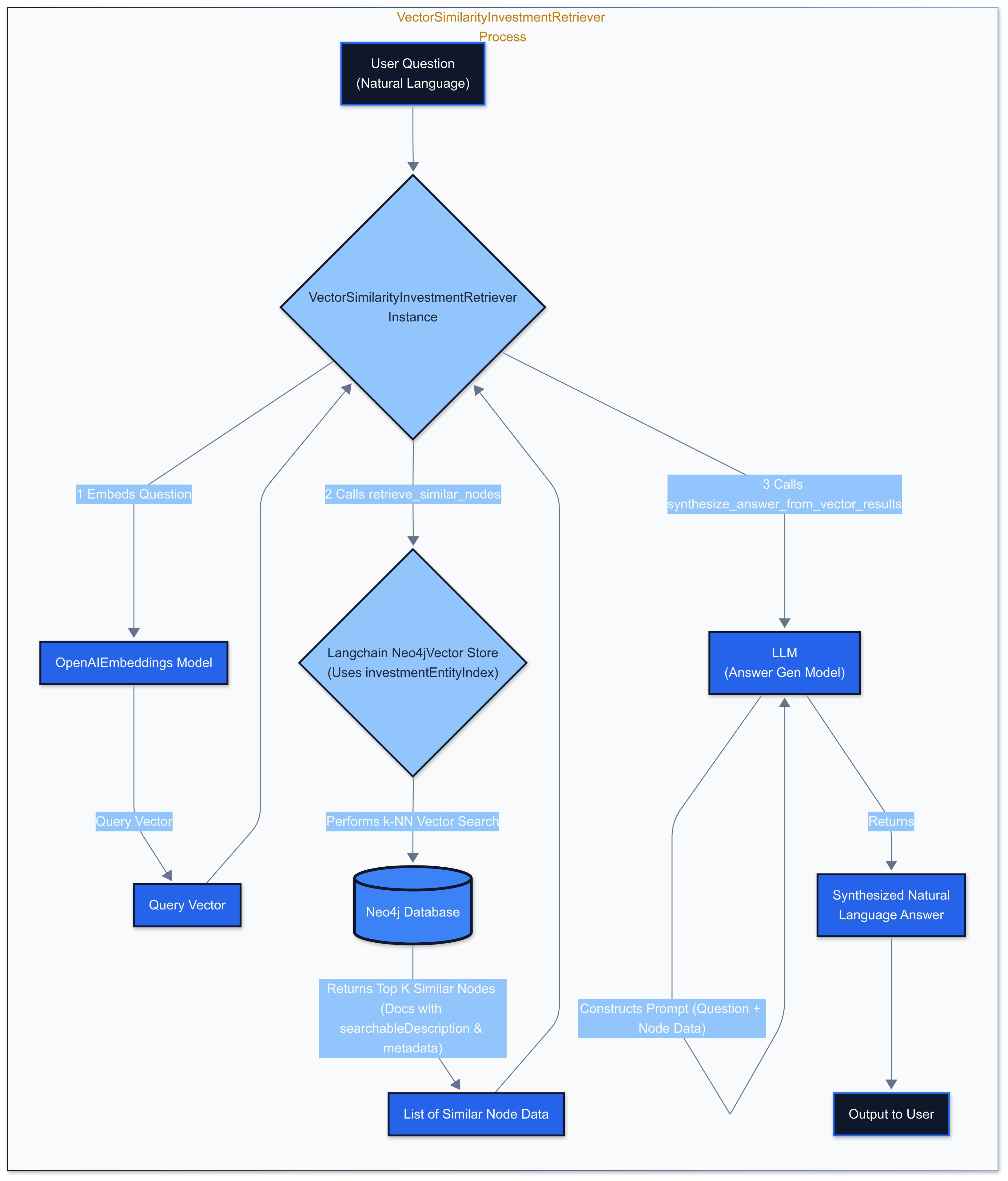
Description: This diagram shows vector similarity retriever
Implementation:
1defretrieve_similar_nodes(self, query_text:str, k:int=5, score_threshold: Optional[float]=None)-> List[Dict[str, Any]]:2 logging.info(f"Performing vector similarity search for: '{query_text}' (k={k})")34# Uses self.vector_store.similarity_search_with_score5# Returns processed results with similarity scores6# ... (implementation)78defsynthesize_answer_from_vector_results(self, question:str, similar_nodes: List[Dict[str, Any]])->str:9 prompt_messages =[10{11"role":"system",12"content":"You are a financial analyst assistant. Based on the user's question and the semantically similar entities retrieved from a knowledge graph, provide a concise and relevant natural language answer."13},14# ... (user prompt with question and context)15]1617# Generate answer using LLM18# ... (implementation)19
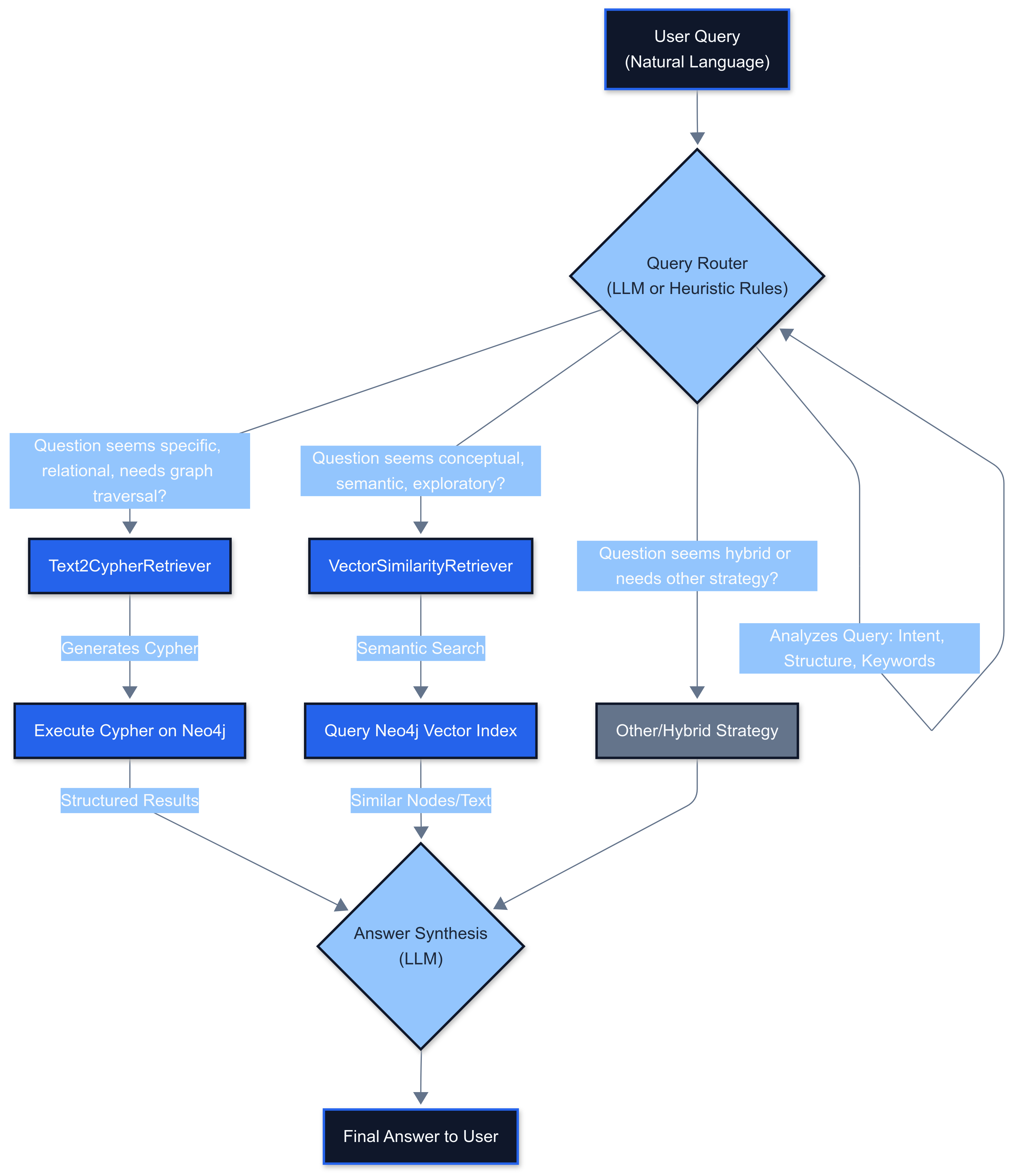
The Router Retriever (Conceptual)
In a production system, a router would analyze incoming queries to select the most appropriate retrieval method:
Text2Cypher: For precise, structural questions requiring exact relationships
Vector Similarity: For conceptual, exploratory questions requiring semantic understanding
Performance, Scalability, and Best Practices
Performance Considerations
KG Query Optimization
Well-defined schemas and indexes on properties like `ticker` and `name`
Cypher query optimization for complex traversals
Connection pooling for database interactions
Vector Index Performance
Neo4j's native vector index performance depends on dataset size and hardware
Consider dedicated vector databases for very large
scale deployments
Batch processing for embedding generation
LLM Call Optimization
Implement retries with exponential backoff
Consider batching for enrichment tasks
Cache LLM responses for identical inputs where appropriate
Common Implementation Pitfalls
Schema Rigidity vs. Flexibility: Design schemas that can evolve with requirements
Prompt Engineering Debt: Version control prompts and maintain prompt libraries
Embedding Drift: Plan for periodic recomputation of embeddings
Cost Management: Monitor LLM API usage with budget alerts
Cypher Query Quality: Validate and log all generated Cypher queries
Data Freshness: Implement robust ETL pipelines for continuous updates
Example: "Find innovative healthcare companies with high forward P/E and focus on personalized medicine"
Advantage: Combines semantic and structured criteria effectively
Vector RAG Is Better For:
Exploratory searches without specific structural requirements
Content-based similarity matching
Quick semantic retrieval without complex relationships
Infrastructure and Monitoring
Infrastructure Options
Neo4j Deployment
Cloud (AuraDB): Managed service with automatic scaling and backups
Self-Managed: Greater control but requires expertise in clustering and tuning
Resource Requirements
Neo4j: Memory-intensive for graph operations, adequate disk for storage
LLM APIs: Network bandwidth, API rate limits consideration
Application Layer: Standard compute resources for RAG pipeline
Technical Monitoring and Observability
Neo4j Monitoring
Query performance metrics
Transaction logs
Cluster health monitoring
Tools: Neo4j Browser, Prometheus exporters
LLM API Monitoring
API call latency and error rates
Token consumption tracking
Cost monitoring
Tools: OpenAI dashboard, LangSmith, Helicone
Application-Level Observability
Detailed logging for each RAG stage
Distributed tracing for complex chains
User feedback mechanisms
Tools: Jaeger, OpenTelemetry
Conclusion: Building ROI-Driven AI with Graph RAG
Combining Knowledge Graphs with LLM-driven RAG techniques provides a powerful paradigm for financial investment intelligence. By structuring data as an interconnected graph and leveraging LLMs for enrichment and natural language interaction, we unlock deeper insights and answer complex, multi-hop questions with greater precision than traditional methods.
Key Technical Recommendations:
Invest in Schema Design: A well-thought-out Knowledge Graph schema is fundamental
Iterative Enrichment: Use LLMs to progressively enrich your KG with inferred properties
Hybrid Retrieval: Combine Text2Cypher precision with vector search exploration
Robust MLOps: Manage prompts as code, monitor performance and costs
Focus on Verifiability: Graph RAG enables tracing answer derivation, crucial for finance
The journey from siloed data to actionable intelligence is complex but highly rewarding. Graph RAG, by embracing the connected nature of data, offers a significant step forward in building next-generation AI-powered financial applications.
If you're an engineering leader or ML engineer looking to architect and implement advanced AI solutions like Graph RAG to solve specific business challenges in finance or other complex domains, I offer AI engineering consulting services. I specialize in moving AI projects from proof-of-concept to robust, scalable, and ROI-driven production systems. Let's discuss how we can transform your data into strategic intelligence.
💻 Explore the Code & Go Deeper!
All the concepts, detailed code examples, and the foundational Jupyter Notebook discussed in this blog post are available in our public GitHub repository. This is your opportunity to:
Get Hands-On: Clone the repository to run the code, experiment with the graph database setup, and test the retrieval mechanisms yourself.
Examine the Implementation: Dive into the specifics of the data enrichment pipeline, vector index creation, and the Text2Cypher/Vector Search retriever classes.
Adapt and Innovate: Use this project as a launchpad for your own advanced RAG solutions in investment intelligence or other domains.
We encourage you to star the repository if you find it useful, and contributions or feedback are always welcome!
If you're an engineering leader or ML engineer looking to architect and implement advanced AI solutions like Graph RAG to solve specific business challenges in finance or other complex domains, I offer AI engineering consulting services. I specialize in moving AI projects from proof-of-concept to robust, scalable, and ROI-driven production systems. Let's discuss how we can transform your data into strategic intelligence. *(Connect with me: LinkedIn | Book a Consultation)*