Production-Ready Agentic AI: A Pragmatic Guide for Engineering Leaders and Teams
May 29, 2025
36 min read
Saumil Srivastava
Engineering Leader
Table Of Contents
Loading content outline...
Executive Summary
For Technical Leadership: 3-Minute Business Overview
Agentic AI represents a fundamental shift from reactive AI tools to autonomous systems that can plan, reason, and execute complex multi-step workflows. Unlike traditional AI that responds to single queries, agentic systems operate continuously, make decisions, and adapt based on outcomes—achieving what Gartner predicts will handle 15% of day-to-day work decisions by 2028 [1].
Key Business Implications:
Implementation Complexity: Custom development requires significant ML engineering expertise and extended timelines
Infrastructure Requirements: GPU-intensive workloads with different scaling patterns than traditional web applications
Team Readiness: Requires specialized skills in ML engineering, prompt engineering, and AI safety practices
Operational Changes: New monitoring, testing, and quality assurance processes for non-deterministic systems
Critical Architecture Decisions:
Memory Strategy: Managed vector databases vs. self-hosted solutions (trade-off between cost and control)
Deployment Model: Container orchestration for control vs. serverless for simplicity
Primary Risk Factors:
Non-deterministic behavior requires new testing methodologies and quality assurance processes
Security vulnerabilities from autonomous tool access demand comprehensive guardrails and audit systems
Scaling economics differ significantly from traditional applications due to GPU and LLM API costs
Immediate Next Steps:
Proof of Concept: Start with constrained use cases to validate approach before full-scale development
Vendor Evaluation (see Appendix A): Assess build vs. buy for each component based on team expertise
Infrastructure Planning: Research actual costs for your scale before committing to architecture decisions
Technical Overview: Understanding Agentic AI Architecture
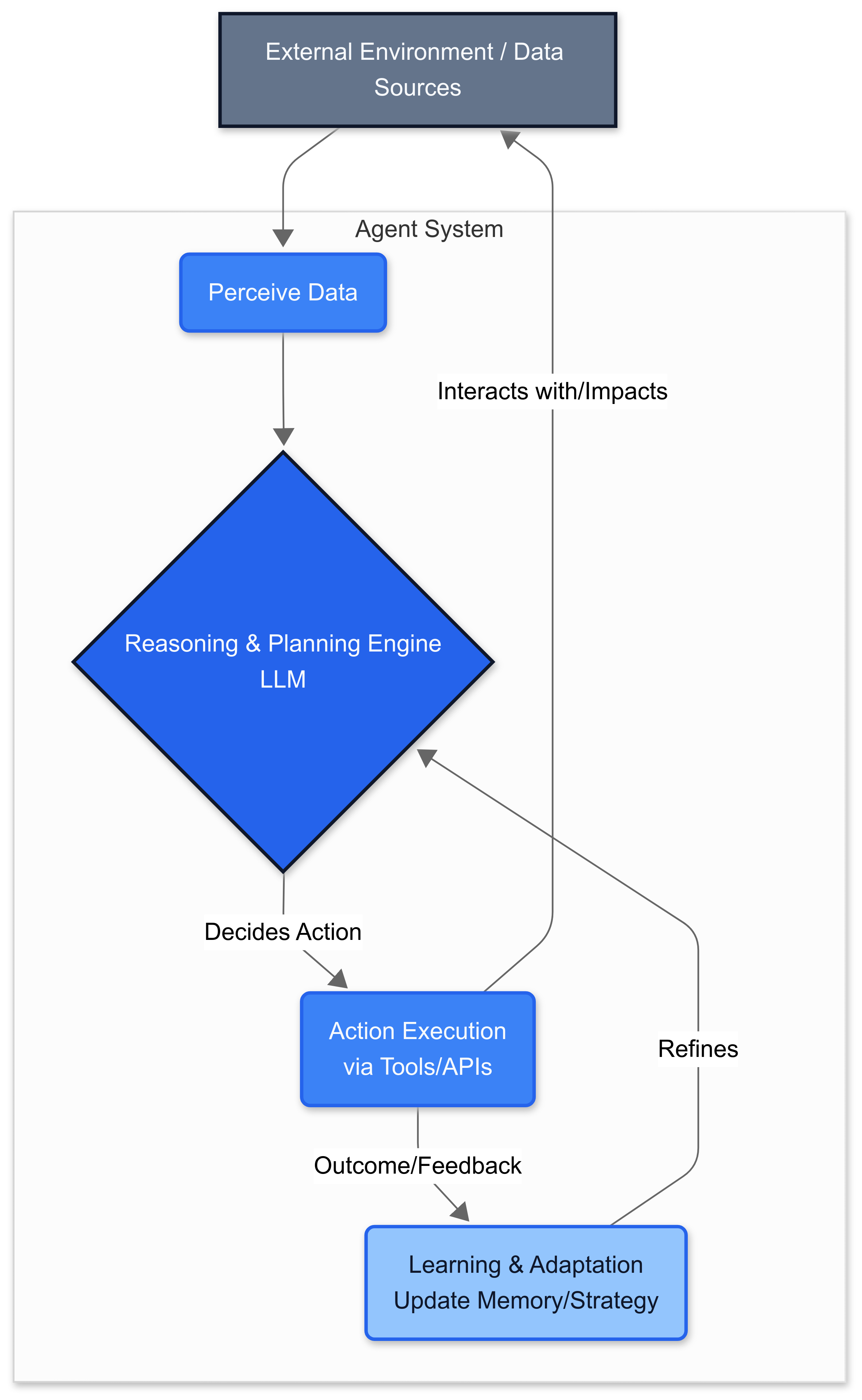
Agentic AI connects to enterprise data and uses sophisticated reasoning and iterative planning to autonomously solve complex, multi-step problems. Unlike traditional AI models that respond to single queries, agentic AI uses a four-step process for problem-solving: Perceive (gather and process data from various sources), Reason (use large language models as orchestrating reasoning engines), Act (execute actions through tool interfaces), and Learn (adapt based on outcomes).
The emergence of agentic AI represents a fundamental shift from stateless AI interactions to persistent, goal-oriented systems that can adapt and learn from their environment.
Defining the Agentic Spectrum
Rather than viewing agency as binary, it exists on a spectrum. Recent research identifies five distinct levels:
Level 1: Action Automation - Basic text classification and templated responses
Understanding this spectrum helps engineering teams set realistic expectations and choose appropriate implementation approaches for their use cases.
💡 Implementation Insight: Most production systems start at Level 2 (Agentic Assistant) and evolve to Level 3 (Plan and Reflect). Attempting Level 4-5 immediately often leads to project failure due to complexity. Begin with constrained, single-domain agents before expanding scope.
Common Implementation Pitfalls and Technical Debt Scenarios
The Reliability and Predictability Challenge
The way we interact with computers today is predictable. For instance, when we build software systems, an engineer sits and writes code, telling the computer exactly what to do, step by step.
With an agentic AI process, we're not telling the agent what to do step by step. Rather, we lead with the outcome we want to achieve, and the agent determines how to reach this goal. The software agent has a degree of autonomy, which means there can be some randomness in the outputs.
This inherent non-determinism creates significant challenges for software engineering teams accustomed to predictable systems. We'll need to put a similar level of effort into minimizing the randomness of agentic AI systems by making them more predictable and reliable.
Integration Complexity and System Brittleness
The integration of agentic AI with existing systems presents notable technical hurdles. Many legacy systems contain outdated APIs, creating compatibility issues between modern AI solutions and existing software.
Additionally, data formats and communication protocols often clash, requiring significant modifications to achieve seamless operation.
Testing and Regression Challenges
As companies race to implement their initial AI use cases, they're encountering challenges with regression testing and traceability—issues amplified by the non-deterministic nature of generative AI.
Traditional testing methodologies fail when dealing with systems that can produce different valid outputs for the same input.
Data Quality and Management Issues
Too often, generative AI models fail to deliver the expected results because they are disconnected from the most accurate, current data.
Agentic AI systems face additional issues because they will need to access data across a wide variety of different platforms and sources.
🎯 Leadership Takeaway: The biggest implementation failures stem from underestimating testing complexity and data integration challenges. Testing agentic systems requires fundamentally different approaches than traditional software. Consider investing in AI testing expertise and methodologies early in the project lifecycle.
Practical Implementation Architecture
When designing agentic AI systems, software engineers must consider the fundamental software architecture principles known as the "-ilities." In the world of software architecture there are many "-ilities" you must take into consideration with every project. Prioritizing them is necessary because the client will optimistically ask that you do all of them. For agentic AI systems, these quality attributes require specialized consideration due to the autonomous and non-deterministic nature of AI agents.
The 7 Critical "-ilities" for Agentic AI Systems
1. Usability: Human-Agent Interaction Design
Software usability can be described as how effectively end users can use, learn, or control the system. For agentic AI, usability extends beyond traditional UI design to include:
Agent Transparency: Users must understand what the agent is doing and why
Control Mechanisms: Clear ways to intervene or override agent decisions
Feedback Loops: Intuitive methods for users to guide and correct agent behavior
Maintainability measures how easily code can be changed; flexibility and testability are core factors. Agentic systems require enhanced maintainability practices:
Model Versioning: Systematic tracking of LLM model updates and prompt iterations
Agent Behavior Documentation: Clear specifications of expected agent decision patterns
Modular Architecture: Separating planning, memory, and tool execution components
Comprehensive Testing: Both deterministic unit tests and stochastic agent behavior validation
3. Scalability: Multi-Agent Coordination
Scalability is the ability for your program to gracefully meet the demand of stress caused by increased usage. Agentic AI scalability involves unique challenges:
Resource Contention: Balancing GPU/CPU allocation across multiple agent processes
State Synchronization: Coordinating shared memory and knowledge bases
Load Distribution: Implementing intelligent agent scheduling and workload balancing
4. Availability: Fault-Tolerant Agent Operations
How long the system is up and running and the Mean Time Between Failure (MTBF) is known as the availability of a program. For agentic systems:
Graceful Degradation: Fallback to simpler decision-making when complex reasoning fails
Agent Health Monitoring: Real-time tracking of agent performance and decision quality
Automatic Recovery: Self-healing mechanisms for common failure patterns
Circuit Breakers: Preventing cascade failures when external tool APIs are unavailable
5. Extensibility: Agent Capability Evolution
Are there points in the system where changes can be made with (or without) program changes? Agentic AI requires dynamic extensibility:
Tool Integration Framework: Plugin architecture for adding new agent capabilities
Dynamic Prompt Management: Runtime modification of agent instructions and goals
Knowledge Base Updates: Hot-swapping of information sources and databases
Behavior Customization: User-configurable agent personality and decision preferences
6. Security: Autonomous System Protection
Security becomes critical when agents operate autonomously. Security is the measure of system's ability to resist unauthorized attempts at usage or behavior modification, while still providing service to legitimate users:
Agent Authorization: Strict controls on what actions agents can perform
Input Validation: Protection against prompt injection and manipulation attacks
Audit Trails: Comprehensive logging of all agent decisions and actions
Sandboxed Execution: Isolated environments for agent tool usage
7. Portability: Cross-Platform Agent Deployment
Portability is the ability for your application to run on numerous platforms. For agentic systems:
Model Agnostic Design: Support for multiple LLM providers and model architectures
Cloud Provider Independence: Deployment flexibility across AWS, Azure, GCP
Container-Based Architecture: Docker/Kubernetes compatibility for consistent deployment
Data Format Standardization: Portable agent memory and knowledge representations
Core Component Architecture
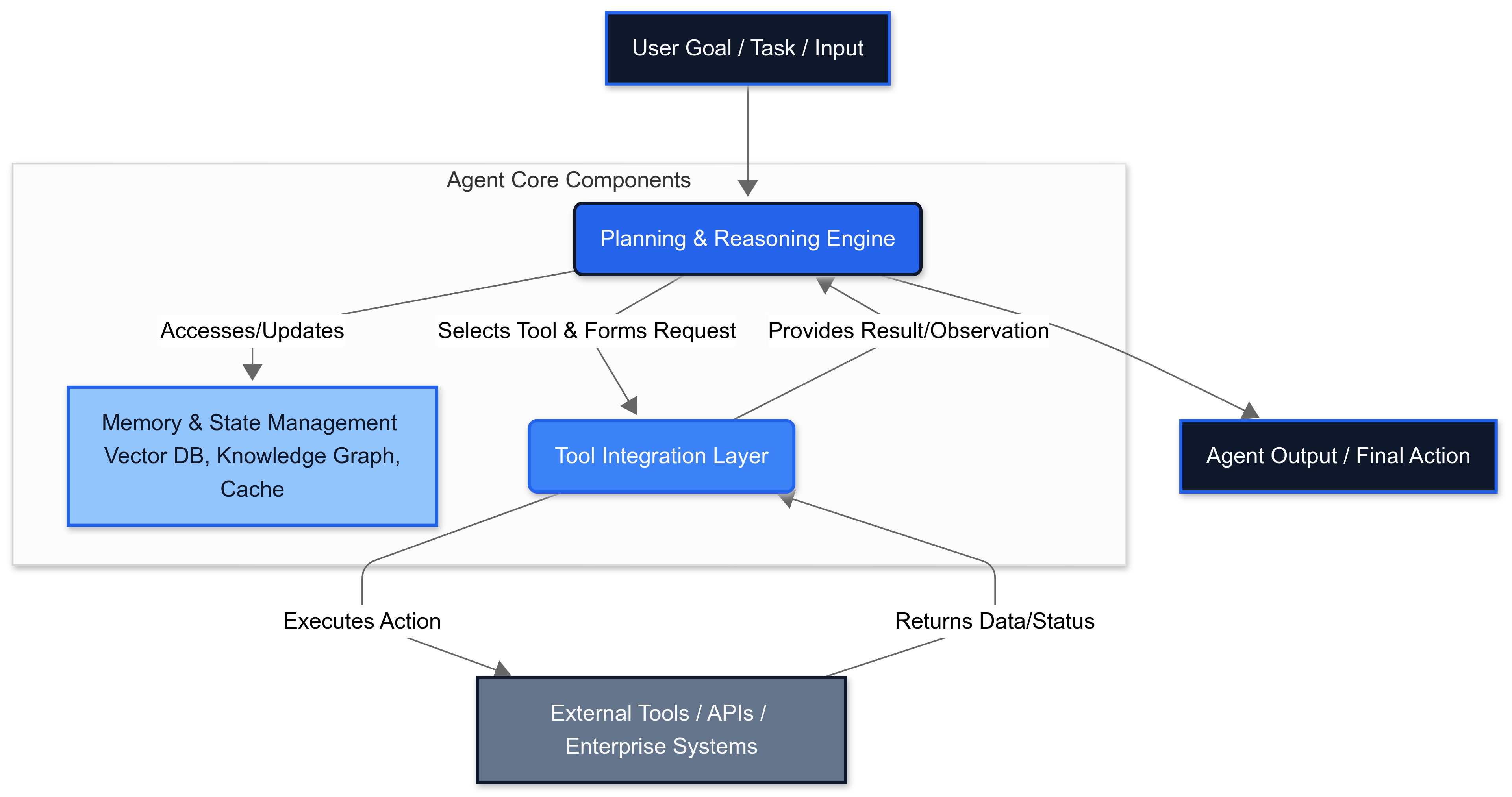
Based on validated implementations and the "-ilities" framework, agentic systems require three fundamental components:
1. Planning and Reasoning Engine
Two dominant patterns emerge from production deployments:
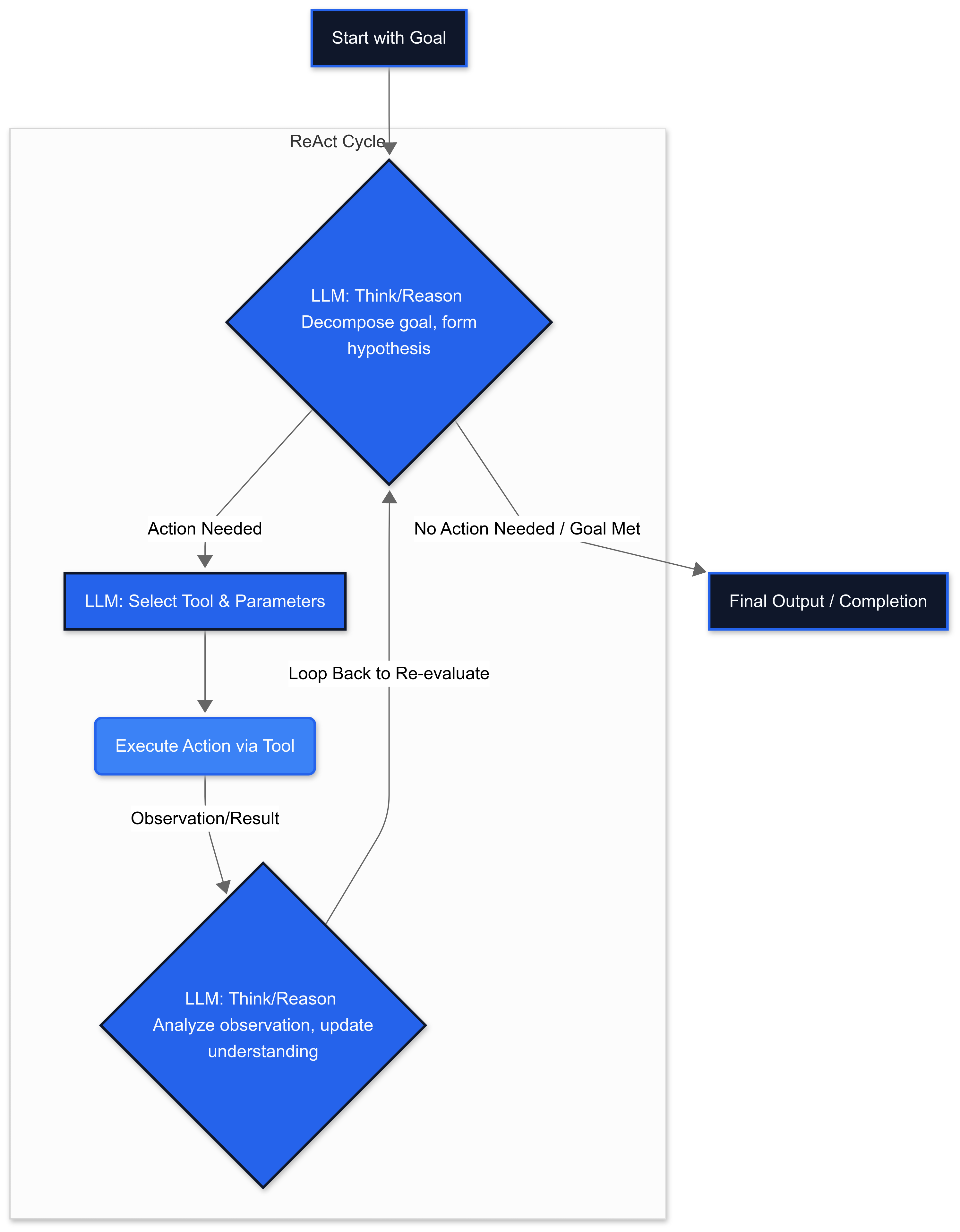
ReAct (Reasoning + Acting)
Tightly interleaves reasoning and action in synergistic loops
Higher adaptability but increased computational cost
Better handling of unexpected outcomes
Plan-and-Execute
Decouples planning from execution phases
More cost-effective but less adaptive to changes
Strategic approach to complex multi-step tasks
2. Tool Integration Layer
Agents rely on external tools—a.k.a. APIs—to execute actions. Reusable APIs will be critical for enabling seamless agentic workflows. Implementation requires:
Structured function calling interfaces
Robust error handling for API failures
Comprehensive authentication and authorization systems
Security controls preventing tool misuse
3. Memory and State Management
AI agent memory refers to an artificial intelligence (AI) system's ability to store and recall past experiences to improve decision-making, perception and overall performance. Unlike traditional AI models that process each task independently, AI agents with memory can retain context, recognize patterns over time and adapt based on past interactions.
💡 Implementation Insight: The "-ilities" framework provides a systematic approach to avoid common architectural debt. Teams that skip this planning phase often face significant refactoring challenges when scaling beyond initial prototypes. Prioritize Maintainability and Security first, as these are hardest to retrofit later.
Prompt-Orchestration Patterns for Production Systems
Certain prompt engineering patterns have emerged as critical for reliable agentic AI systems. As Anthropic notes in their guide on building effective agents [4], "Consistently, the most successful implementations weren't using complex frameworks or specialized libraries. Instead, they were building with simple, composable patterns."
1. Execution Loop & Run-Loop Prompting
The foundation of agentic behavior is the execution loop pattern. As documented in LangGraph's agentic concepts [5], "In a tool-calling agent, an LLM is called repeatedly in a while-loop. At each step the agent decides which tools to call, and what the inputs to those tools should be."
Run-Loop Controller Implementation
1import json
2from typing import Dict, List
34classRunLoopController:5"""Run-loop prompting with safe exit criteria"""67def__init__(self, max_iterations:int=10):8 self.max_iterations = max_iterations
9 self.loop_template ="""
10You are in an execution loop. At each step, you must decide to either:
111. CONTINUE - Take another action toward the goal
122. FINISH - You have completed the task successfully
1314Current goal: {goal}
15Step: {current_step}/{max_steps}
16Previous actions: {action_history}
17Current observations: {observations}
1819Think step by step:
201. Have I achieved the goal? If yes, respond with FINISH
212. What is the next logical action? If unclear, respond with FINISH
223. If continuing, specify exactly one action
2324Response format:
25{{"decision": "CONTINUE|FINISH", "reasoning": "...", "action": "..."}}
26"""2728asyncdefexecute_loop(self, goal:str, agent_core)-> Dict:29"""Execute run-loop with safe termination"""3031 action_history =[]32 observations =[]3334for step inrange(self.max_iterations):35 prompt = self.loop_template.format(36 goal=goal,37 current_step=step +1,38 max_steps=self.max_iterations,39 action_history=action_history[-3:],# Last 3 actions for context40 observations=observations[-3:]41)4243 response =await agent_core.llm.generate(prompt)4445try:46 decision_data = json.loads(response)4748if decision_data.get("decision")=="FINISH":49return{50"status":"completed",51"reason": decision_data.get("reasoning",""),52"total_steps": step +153}54elif decision_data.get("decision")=="CONTINUE":55# Execute the specified action56 action_result =await self._execute_action(57 decision_data.get("action",""), agent_core
58)59 action_history.append(decision_data.get("action",""))60 observations.append(action_result)61else:62# Invalid decision format - force finish63return{"status":"error","reason":"Invalid decision format"}6465except json.JSONDecodeError:66# Parsing failed - force finish for safety67return{"status":"error","reason":"Response parsing failed"}6869# Max iterations reached70return{"status":"timeout","reason":f"Exceeded {self.max_iterations} steps"}7172asyncdef_execute_action(self, action:str, agent_core)->str:73"""Execute action via tool registry"""74raise NotImplementedError("Connect to ToolRegistry.execute() in production")75
2. Input Routing & Semantic Dispatch
For production systems handling diverse queries, input classification and routing are essential. "A router allows an LLM to select a single step from a specified set of options."
Semantic Router Implementation
1import json
2from typing import Dict
34classSemanticRouter:5"""Input classification and dispatch to specialized handlers"""67def__init__(self):8 self.routing_template ="""
9Classify the user input into exactly one category:
1011Categories:
12- SUPPORT: Customer service, account issues, troubleshooting
13- CODING: Software development, debugging, technical questions
14- DATA_REQUEST: Information lookup, research, analysis
15- DESTRUCTIVE: Account deletion, data removal, security actions
16- GENERAL: Casual conversation, greetings, unclear requests
1718User input: "{user_input}"
1920Response format (JSON only):
21{{`category`: `CATEGORY_NAME`, `confidence`: 0.95, `reasoning`: `brief explanation`}}
22"""2324asyncdefroute_request(self, user_input:str, llm_client)-> Dict:25"""Route user input to appropriate handler"""2627 prompt = self.routing_template.format(user_input=user_input)28 response =await llm_client.generate(prompt)2930try:31 routing_data = json.loads(response)32 category = routing_data.get("category","GENERAL")3334# Route to specialized sub-prompts based on category35if category =="SUPPORT":36returnawait self._handle_support_request(user_input, llm_client)37elif category =="CODING":38returnawait self._handle_coding_request(user_input, llm_client)39elif category =="DESTRUCTIVE":40returnawait self._handle_destructive_request(user_input, llm_client)41else:42returnawait self._handle_general_request(user_input, llm_client)4344except json.JSONDecodeError:45# Default to general handler if parsing fails46returnawait self._handle_general_request(user_input, llm_client)4748asyncdef_handle_support_request(self, input_text:str, llm_client)-> Dict:49"""Specialized prompt for customer support scenarios"""50 support_prompt =f"""
51You are a customer support agent. For this request: "{input_text}"
52531. Identify the customer's primary issue
542. Suggest up to 3 specific troubleshooting steps
553. Escalate to human if the issue involves: billing, legal, or complex technical problems
5657Response as JSON: {{"issue_type": "...", "steps": [...], "escalate": boolean}}
58"""59 response =await llm_client.generate(support_prompt)60return{"category":"support","response": response}6162asyncdef_handle_coding_request(self, input_text:str, llm_client)-> Dict:63"""Specialized prompt for coding assistance"""64# Implementation for coding requests65return{"category":"coding","response":"Coding assistance provided"}6667asyncdef_handle_destructive_request(self, input_text:str, llm_client)-> Dict:68"""Handle destructive actions with extra validation"""69# Implementation with additional safety checks70return{"category":"destructive","response":"Destructive action requires confirmation"}7172asyncdef_handle_general_request(self, input_text:str, llm_client)-> Dict:73"""Handle general conversations"""74# Implementation for general chat75return{"category":"general","response":"General response provided"}76
3. Structured Response & JSON Schema Validation
Modern agentic systems require structured outputs for reliable processing. As highlighted by industry best practices, "When working with LLMs, an extremely valuable use case is generating structured data as the output response of the AI prompt."
Structured Response Handler
1import json
2from typing import Dict, List, Optional, Any
3from pydantic import BaseModel, ValidationError
45classAgentResponse(BaseModel):6"""Structured response schema for agent outputs"""7 action_type:str8 parameters: Dict[str, Any]9 confidence:float10 reasoning:str11 next_steps: Optional[List[str]]=None1213classStructuredResponseHandler:14"""Enforce JSON schema validation for all agent responses"""1516def__init__(self):17 self.schema_template ="""
18You must respond with valid JSON matching this exact schema:
19{{
20 `action_type`: `string (required)`,
21 `parameters`: {{`key`: `value`}},
22 `confidence`: 0.95,
23 `reasoning`: `string explaining your decision`,
24 `next_steps`: [`optional`, `array`, `of`, `strings`]
25}}
2627User request: {user_input}
28Available actions: {available_actions}
2930JSON response:
31"""3233asyncdefget_structured_response(self, user_input:str,34 available_actions: List[str],35 llm_client)-> AgentResponse:36"""Get validated structured response from LLM"""3738 prompt = self.schema_template.format(39 user_input=user_input,40 available_actions=available_actions
41)4243 max_retries =344for attempt inrange(max_retries):45try:46 response =await llm_client.generate(prompt)4748# Parse and validate against Pydantic schema49 response_data = json.loads(response)50 validated_response = AgentResponse(**response_data)5152return validated_response
5354except(json.JSONDecodeError, ValidationError)as e:55if attempt == max_retries -1:56# Final attempt failed - return safe default57return AgentResponse(58 action_type="error",59 parameters={"error":str(e)},60 confidence=0.0,61 reasoning=f"Failed to parse response after {max_retries} attempts"62)6364# Retry with error feedback65 prompt +=f"\n\nPrevious attempt failed with error: {str(e)}. Please provide valid JSON."66
4. Prompt Hygiene & Boundary Signaling
Clear prompt structure and boundary markers improve response reliability. Structured syntax: Using an XML-like format, with examples, ensures that tool use is clear and easy to debug.
Prompt Hygiene Implementation
1import json
2from typing import Dict, List, Optional, Any
34classPromptHygienizer:5"""Standardized prompt formatting with clear boundaries"""67@staticmethod8defformat_system_prompt(capabilities: List[str], limitations: List[str])->str:9"""Declarative intent with clear capability boundaries"""10returnf"""
11--- SYSTEM CONTEXT ---
12You are an AI agent with these specific capabilities:
13{chr(10).join('• '+ cap for cap in capabilities)}1415Important limitations:
16{chr(10).join('• '+ lim for lim in limitations)}1718--- INSTRUCTIONS ---
191. Always operate within your defined capabilities
202. Use structured responses with JSON formatting
213. Explain your reasoning for each decision
224. Request clarification when inputs are ambiguous
2324--- TOOLS AVAILABLE ---
25Use this exact format for tool calls:
26<tool_name>
27<parameter_name>value</parameter_name>
28</tool_name>
2930--- RESPONSE FORMAT ---
31Always structure responses as JSON with required fields
32"""3334@staticmethod35defformat_user_message(user_input:str, context: Dict =None)->str:36"""Structured user message with clear boundaries"""37 formatted_message =f"""
38--- USER REQUEST ---
39{user_input}40"""4142if context:43 formatted_message +=f"""
44--- CONTEXT ---
45{json.dumps(context, indent=2)}46"""4748 formatted_message +="\n--- AGENT RESPONSE ---\n"49return formatted_message
50
5. Hallucination-Mitigation Hooks
Production agentic systems require multiple layers of validation. Since errors tend to compound as you go down the agent's trajectory, structured outputs and validation are critical.
Hallucination Mitigation System
1import json
2from typing import Dict, List, Optional, Any
34classHallucinationMitigation:5"""Multiple validation layers to catch and correct hallucinations"""67def__init__(self, knowledge_base, fact_checker):8 self.knowledge_base = knowledge_base
9 self.fact_checker = fact_checker
1011asyncdefvalidate_response(self, agent_response:str,12 original_query:str)-> Dict:13"""Multi-layer validation pipeline"""1415 validation_results ={16"schema_valid":False,17"factually_accurate":False,18"contextually_relevant":False,19"final_score":0.0,20"corrections":[]21}2223# Layer 1: Schema validation24try:25 parsed_response = json.loads(agent_response)26 validation_results["schema_valid"]=True27except json.JSONDecodeError:28 validation_results["corrections"].append("Invalid JSON format")29return validation_results
3031# Layer 2: Fact checking against knowledge base32 facts_mentioned =await self._extract_factual_claims(agent_response)33 fact_accuracy =await self._verify_facts(facts_mentioned)34 validation_results["factually_accurate"]= fact_accuracy >0.83536ifnot validation_results["factually_accurate"]:37 validation_results["corrections"].append("Potential factual inaccuracies detected")3839# Layer 3: Relevance check40 relevance_score =await self._check_relevance(agent_response, original_query)41 validation_results["contextually_relevant"]= relevance_score >0.74243ifnot validation_results["contextually_relevant"]:44 validation_results["corrections"].append("Response may be off-topic")4546# Calculate final validation score47 validation_results["final_score"]=(480.3* validation_results["schema_valid"]+490.4* validation_results["factually_accurate"]+500.3* validation_results["contextually_relevant"]51)5253return validation_results
5455asyncdef_extract_factual_claims(self, text:str)-> List[str]:56"""Extract factual claims from text for verification"""57# Simplified implementation - use NLP entity extraction in production58# Split text into sentences and filter for factual statements59 sentences = text.split('.')60 factual_claims =[s.strip()for s in sentences iflen(s.strip())>10andany(61 keyword in s.lower()for keyword in['is','was','has','can','will','according to']62)]63return factual_claims[:5]# Limit to first 5 claims6465asyncdef_check_relevance(self, response:str, query:str)->float:66"""Check response relevance to original query"""67# Simplified implementation - use semantic similarity in production68 response_words =set(response.lower().split())69 query_words =set(query.lower().split())7071ifnot response_words ornot query_words:72return0.07374 overlap = response_words.intersection(query_words)75returnlen(overlap)/len(query_words)7677asyncdef_verify_facts(self, facts: List[str])->float:78"""Verify factual claims against reliable sources"""79ifnot facts:80return1.08182 verified_count =083for fact in facts:84# Check against knowledge base85 kb_result =await self.knowledge_base.verify_fact(fact)86if kb_result.confidence >0.8:87 verified_count +=188else:89# Secondary check with external fact checker90 ext_result =await self.fact_checker.verify(fact)91if ext_result.verified:92 verified_count +=19394return verified_count /len(facts)95
Enhanced Memory and Planning Architecture
Building on the "-ilities" framework and prompt-orchestration patterns, here's a production-ready implementation:
Memory Implementation
Memory Store Architecture
1import json
2from typing import Dict, List, Optional, Any
3from datetime import datetime
4from dataclasses import dataclass
5from abc import ABC, abstractmethod
67@dataclass8classMemoryEntry:9"""Base memory entry with temporal metadata"""10id:str11 content: Dict
12 timestamp: datetime
13 memory_type:str14 validity_start: Optional[datetime]=None15 validity_end: Optional[datetime]=None1617classMemoryStore(ABC):18"""Abstract base class for memory implementations"""1920@abstractmethod21asyncdefstore(self, entry: MemoryEntry)->str:22pass2324@abstractmethod25asyncdefretrieve(self, query:str, limit:int=10)-> List[MemoryEntry]:26pass2728@abstractmethod29asyncdefupdate(self, entry_id:str, content: Dict)->bool:30pass3132classVectorMemoryStore(MemoryStore):33"""Vector database implementation for semantic memory"""3435def__init__(self, vector_db_client, embedding_model):36 self.client = vector_db_client
37 self.embedding_model = embedding_model
3839asyncdefstore(self, entry: MemoryEntry)->str:40"""Store memory entry with vector embeddings"""41 embedding =await self.embedding_model.embed(str(entry.content))4243 doc ={44"id": entry.id,45"content": entry.content,46"embedding": embedding,47"timestamp": entry.timestamp.isoformat(),48"memory_type": entry.memory_type,49"validity_start": entry.validity_start.isoformat()if entry.validity_start elseNone,50"validity_end": entry.validity_end.isoformat()if entry.validity_end elseNone51}5253await self.client.upsert([doc])54return entry.id5556asyncdefretrieve(self, query:str, limit:int=10)-> List[MemoryEntry]:57"""Retrieve semantically similar memories"""58 query_embedding =await self.embedding_model.embed(query)5960 results =await self.client.query(61 vector=query_embedding,62 top_k=limit,63 include_metadata=True64)6566return[self._deserialize_entry(result)for result in results.matches]6768def_deserialize_entry(self, result)-> MemoryEntry:69"""Convert database result to MemoryEntry"""70 metadata = result.metadata
7172# Validate required fields exist73 required_fields =["id","content","timestamp","memory_type"]74for field in required_fields:75if field notin metadata:76raise ValueError(f"Memory corruption: missing required field '{field}'")7778# Safely parse timestamps with corruption protection79try:80 timestamp = datetime.fromisoformat(metadata["timestamp"])81except(ValueError, TypeError)as e:82raise ValueError(f"Memory corruption: invalid timestamp format '{metadata['timestamp']}'")from e
8384 validity_start_str = metadata.get("validity_start")85 validity_end_str = metadata.get("validity_end")8687 validity_start =None88 validity_end =None8990if validity_start_str:91try:92 validity_start = datetime.fromisoformat(validity_start_str)93except(ValueError, TypeError):94pass# Invalid format, keep as None9596if validity_end_str:97try:98 validity_end = datetime.fromisoformat(validity_end_str)99except(ValueError, TypeError):100pass# Invalid format, keep as None101102return MemoryEntry(103id=metadata["id"],104 content=metadata["content"],105 timestamp=timestamp,106 memory_type=metadata["memory_type"],107 validity_start=validity_start,108 validity_end=validity_end
109)110111112
*For production-ready prompt management and agent orchestration platforms, see Appendix A: Prompt & Agent Framework Tools.*
> 💡 Implementation Insight: These five prompt-orchestration patterns address the majority of production reliability issues. Teams that implement structured response validation and hallucination mitigation from the start report significantly fewer production incidents. The initial engineering investment pays dividends in operational stability.
Planning Engine
Agent Planning Implementation
1import asyncio
2import json
3import logging
4import uuid
5from enum import Enum
6from typing import Any, Dict, List, Optional
7from datetime import datetime
89classPlanningMode(Enum):10 REACT ="react"11 PLAN_EXECUTE ="plan_execute"1213classAgentAction:14"""Represents an action the agent can take"""15def__init__(self, tool_name:str, parameters: Dict[str, Any], reasoning:str=""):16 self.tool_name = tool_name
17 self.parameters = parameters
18 self.reasoning = reasoning
19 self.result: Optional[Any]=None20 self.error: Optional[str]=None2122classAgentPlan:23"""Represents a multi-step plan"""24def__init__(self, goal:str, steps: List[str]):25 self.goal = goal
26 self.steps = steps
27 self.current_step =028 self.completed_steps: List[bool]=[False]*len(steps)2930classAgentPlanner:31"""Core planning and reasoning engine"""3233def__init__(self, llm_client, tool_registry, memory_store, mode: PlanningMode = PlanningMode.REACT):34 self.llm = llm_client
35 self.tools = tool_registry
36 self.memory = memory_store
37 self.mode = mode
38 self.logger = logging.getLogger(__name__)3940asyncdefexecute_goal(self, goal:str, max_iterations:int=10)-> Dict[str, Any]:41"""Execute a goal using the configured planning mode"""4243if self.mode == PlanningMode.REACT:44returnawait self._execute_react(goal, max_iterations)45else:46returnawait self._execute_plan_and_execute(goal)4748def_parse_action(self, action_text:str)-> Optional[AgentAction]:49"""Parse LLM response into structured action"""50if":"in action_text and"{"in action_text:51try:52 parts = action_text.split(":",1)53 tool_name = parts[0].strip()54 params_str = parts[1].strip()5556# Use JSON parsing instead of eval for security57try:58 parameters = json.loads(params_str)59except json.JSONDecodeError:60# Fallback for simple parameter strings61 parameters ={"input": params_str}6263return AgentAction(tool_name, parameters)64except Exception as e:65 self.logger.error(f"Failed to parse action: {e}")66returnNone6768asyncdef_execute_react(self, goal:str, max_iterations:int)-> Dict[str, Any]:69"""ReAct implementation: interleaved reasoning and acting"""7071 context ={"goal": goal,"observations":[],"actions":[],"thoughts":[]}7273for iteration inrange(max_iterations):74# Retrieve relevant memories75 relevant_memories =await self.memory.retrieve(goal, limit=5)76 context["memories"]=[mem.content for mem in relevant_memories]7778# Generate reasoning79 thought_prompt = self._build_react_prompt(context,"thought")80 thought =await self.llm.generate(thought_prompt)81 context["thoughts"].append(thought)8283# Determine if action is needed84 action_prompt = self._build_react_prompt(context,"action")85 action_response =await self.llm.generate(action_prompt)8687if"FINISH"in action_response:88break8990# Parse and execute action91 action = self._parse_action(action_response)92if action:93try:94 result =await self.tools.execute(action.tool_name, action.parameters)95 action.result = result
96 context["actions"].append(action)97 context["observations"].append(result)9899# Store experience in memory100await self._store_experience(goal, action, result)101102except Exception as e:103 action.error =str(e)104 context["observations"].append(f"Error: {e}")105 self.logger.error(f"Action execution failed: {e}")106107return{108"success":"FINISH"in action_response if'action_response'inlocals()elseFalse,109"context": context,110"iterations": iteration +1111}112113def_build_react_prompt(self, context: Dict, prompt_type:str)->str:114"""Build ReAct-style prompts for reasoning"""115 base_context =f"""
116 Goal: {context['goal']}117 Previous thoughts: {context['thoughts'][-3:] if context['thoughts'] else 'None'}118 Previous actions: {[a.tool_name for a in context['actions'][-3:]] if context['actions'] else 'None'}119 Recent observations: {context['observations'][-3:] if context['observations'] else 'None'}120 Relevant memories: {context.get('memories',[])}121 """122123if prompt_type =="thought":124return base_context +"\nThought: What should I consider next?"125elif prompt_type =="action":126return base_context +f"\nAvailable tools: {list(self.tools.list_tools())}\nAction: (tool_name: parameters) or FINISH"127128asyncdef_store_experience(self, goal:str, action: AgentAction, result: Any):129"""Store successful experiences in memory"""130 experience = MemoryEntry(131id=str(uuid.uuid4()),132 content={133"goal": goal,134"action": action.tool_name,135"parameters": action.parameters,136"result":str(result)[:1000],# Truncate long results137"success": action.error isNone138},139 timestamp=datetime.now(),140 memory_type="episodic"141)142await self.memory.store(experience)143
Agent Health Monitoring
Health Monitoring System
1import logging
2from typing import Dict, List, Optional, Any
3from datetime import datetime
45classAgentHealthMonitor:6"""Availability: Health monitoring and fault tolerance for agent systems"""78def__init__(self, alert_thresholds: Dict[str,float]):9 self.alert_thresholds = alert_thresholds
10 self.agent_health_data ={}11 self.circuit_breakers ={}1213asyncdefmonitor_agent_health(self, agent_id:str, execution_metrics: Dict):14"""Monitor agent performance and trigger alerts for degradation"""1516 health_score = self._calculate_health_score(execution_metrics)17 self.agent_health_data[agent_id]={18"health_score": health_score,19"last_check": datetime.now(),20"metrics": execution_metrics
21}2223# Check for health degradation24if health_score < self.alert_thresholds["critical_health"]:25await self._trigger_health_alert(agent_id,"critical", health_score)26await self._initiate_recovery_procedure(agent_id)27elif health_score < self.alert_thresholds["warning_health"]:28await self._trigger_health_alert(agent_id,"warning", health_score)2930def_calculate_health_score(self, metrics: Dict)->float:31"""Calculate composite health score from multiple metrics
3233 Weights based on SRE best practices:
34 - Success rate: 40% (primary indicator of agent effectiveness)
35 - Response latency: 30% (user experience impact)
36 - Error rate: 20% (system reliability)
37 - Resource usage: 10% (operational efficiency)
38 """39 weights ={40"success_rate":0.4,41"response_latency":0.3,42"error_rate":0.2,43"resource_usage":0.144}4546# Normalize metrics to 0-1 scale47 normalized_success = metrics.get("success_rate",0.5)48 normalized_latency =max(0,1-(metrics.get("avg_latency_ms",1000)/5000))49 normalized_errors =max(0,1- metrics.get("error_rate",0.5))50 normalized_resources =max(0,1- metrics.get("cpu_usage",0.5))5152 health_score =(53 weights["success_rate"]* normalized_success +54 weights["response_latency"]* normalized_latency +55 weights["error_rate"]* normalized_errors +56 weights["resource_usage"]* normalized_resources
57)5859return health_score
6061asyncdef_trigger_health_alert(self, agent_id:str, severity:str, score:float):62"""Trigger health alert notification"""63# Implementation for alert system integration64pass6566asyncdef_initiate_recovery_procedure(self, agent_id:str):67"""Availability: Automatic recovery mechanisms"""68# Implement graceful degradation69await self._enable_simple_mode(agent_id)70# Restart agent with basic configuration71await self._restart_agent_safely(agent_id)7273asyncdef_enable_simple_mode(self, agent_id:str):74"""Enable simplified operation mode"""75# Implementation for fallback mode76pass7778asyncdef_restart_agent_safely(self, agent_id:str):79"""Safe agent restart procedure"""80# Implementation for safe restart81pass828384
*For AI-specific health monitoring and reliability platforms, see Appendix A: Health Monitoring & Reliability Tools.*
Tool Registry & Security
Secure Tool Registry
1import logging
2from typing import Dict, List, Optional, Any, Callable
34classExtensibleToolRegistry:5"""Extensibility: Dynamic tool integration for agents"""67def__init__(self):8 self.tools ={}9 self.tool_schemas ={}10 self.security_policies ={}1112defregister_tool(self, tool_name:str, tool_impl: Callable,13 schema: Dict, security_policy: Dict):14"""Extensibility: Register new tools at runtime"""1516# Validate tool implementation17ifnot self._validate_tool_interface(tool_impl):18raise ValueError(f"Tool {tool_name} does not implement required interface")1920# Security: Apply access controls21ifnot self._validate_security_policy(security_policy):22raise ValueError(f"Invalid security policy for tool {tool_name}")2324 self.tools[tool_name]= tool_impl
25 self.tool_schemas[tool_name]= schema
26 self.security_policies[tool_name]= security_policy
2728 logging.info(f"Registered new tool: {tool_name}")2930asyncdefexecute(self, tool_name:str, parameters: Dict,31 agent_id:str=None, context: Dict =None)-> Any:32"""Security: Controlled tool execution with authorization"""3334# Security: Verify agent authorization35if agent_id andnot self._check_agent_authorization(agent_id, tool_name):36raise PermissionError(f"Agent {agent_id} not authorized for tool {tool_name}")3738# Security: Validate input parameters39ifnot self._validate_parameters(tool_name, parameters):40raise ValueError(f"Invalid parameters for tool {tool_name}")4142# Execute with sandboxing43try:44 result =await self._execute_sandboxed(tool_name, parameters, context or{})4546# Audit logging for security47await self._log_tool_execution(agent_id, tool_name, parameters, result)4849return result
5051except Exception as e:52# Security: Log potential security violations53await self._log_security_event(agent_id, tool_name,str(e))54raise5556deflist_tools(self)-> List[str]:57"""Return list of available tools"""58returnlist(self.tools.keys())5960def_validate_tool_interface(self, tool_impl: Callable)->bool:61"""Maintainability: Ensure consistent tool interfaces"""62# Check for required methods and signatures63 required_methods =["execute","validate_input","get_schema"]64returnall(hasattr(tool_impl, method)for method in required_methods)6566def_validate_security_policy(self, policy: Dict)->bool:67"""Validate security policy structure"""68 required_fields =["allowed_agents","rate_limit","audit_level"]69returnall(field in policy for field in required_fields)7071def_check_agent_authorization(self, agent_id:str, tool_name:str)->bool:72"""Check if agent is authorized to use tool"""73 policy = self.security_policies.get(tool_name,{})74 allowed_agents = policy.get("allowed_agents",[])75return"*"in allowed_agents or agent_id in allowed_agents
7677def_validate_parameters(self, tool_name:str, parameters: Dict)->bool:78"""Validate parameters against tool schema"""79 schema = self.tool_schemas.get(tool_name,{})80# Simplified validation - use proper JSON schema validation in production81 required_params = schema.get("required",[])82returnall(param in parameters for param in required_params)8384asyncdef_execute_sandboxed(self, tool_name:str, parameters: Dict, context: Dict)-> Any:85"""Execute tool in sandboxed environment"""86 tool = self.tools[tool_name]87returnawait tool.execute(parameters, context)8889asyncdef_log_tool_execution(self, agent_id:str, tool_name:str, parameters: Dict, result: Any):90"""Log tool execution for audit trail"""91# Implementation for audit logging92pass9394asyncdef_log_security_event(self, agent_id:str, tool_name:str, error:str):95"""Log security-related events"""96# Implementation for security event logging97pass9899100
*For API gateway, integration platforms, and security tools, see Appendix A: Tool Integration & API Management.*
Benchmarking and Performance Evaluation
Established Benchmarking Frameworks
For rigorous assessment of agentic AI systems, leverage these validated benchmarks:
SWE-bench for Code Generation Capabilities
SWE-bench measures AI agents' capability to resolve GitHub issues [9]. The benchmark utilizes GitHub as a rich resource of Python software bugs across 16 repositories and provides a mechanism for measuring how well the LLM-based AI agents can solve them.
Current performance shows significant improvement: Today, the SWE-bench leaderboard shows the top-scoring model resolved 55% of the coding issues on SWE-bench Lite, which is a subset of the benchmark designed to make evaluation less costly and more accessible.
AgentBench for Multi-Domain Evaluation
AgentBench is a comprehensive benchmark designed to evaluate LLMs as agents in interactive environments [10]. It currently consists of eight distinct environments, each representing different scenarios including SQL-based environments, game-based environments, and web-based environments for shopping and browsing.
τ-Bench for Real-World Dynamic Interactions
Drawing on experience with live agents in production, τ-bench tests an agent's ability to follow rules, reason, remember information over long and complex contexts, and communicate effectively in realistic conversations [11].
Key Performance Metrics
Based on production deployments, track these validated metrics:
System Performance Metrics:
Task completion rate and accuracy
Response latency (P50, P95, P99)
Resource utilization (CPU, GPU, memory)
API call efficiency and error rates
Agentic-Specific Metrics:
Autonomy level (frequency of human interventions required)
Goal achievement rate across different complexity levels
Adaptability score (consistency across scenario variations)
Tool selection accuracy and parameter quality
Production Quality Metrics:
pass@k: measures the probability an agent succeeds at least once in k attempts
Context adherence and memory utilization
Safety guardrail effectiveness and false positive rates
Benchmarking Implementation
1import asyncio
2import time
3import statistics
4from typing import Dict, List, Tuple, Optional, Any
5from dataclasses import dataclass
67@dataclass8classBenchmarkResult:9"""Individual benchmark test result"""10 test_id:str11 success:bool12 latency_ms:float13 accuracy_score:float14 error_message: Optional[str]=None1516classAgentBenchmarkSuite:17"""Comprehensive benchmarking suite for agentic AI systems"""1819def__init__(self, agent, test_cases: List[Dict]):20 self.agent = agent
21 self.test_cases = test_cases
2223asyncdefrun_benchmark(self, iterations:int=3)-> Dict[str,any]:24"""Run comprehensive benchmark suite"""2526 results =[]2728for test_case in self.test_cases:29 test_results =[]3031# Run each test multiple times for reliability measurement32for iteration inrange(iterations):33 result =await self._run_single_test(test_case, iteration)34 test_results.append(result)3536 results.extend(test_results)3738return self._analyze_results(results)3940asyncdef_run_single_test(self, test_case: Dict, iteration:int)-> BenchmarkResult:41"""Execute a single benchmark test"""4243 test_id =f"{test_case['id']}_iter_{iteration}"44 start_time = time.time()4546try:47# Execute agent task48 result =await self.agent.execute_goal(49 goal=test_case['goal'],50 max_iterations=test_case.get('max_iterations',10)51)5253 latency =(time.time()- start_time)*10005455# Evaluate result quality56 accuracy = self._evaluate_accuracy(result, test_case['expected'])57 success = accuracy >= test_case.get('success_threshold',0.8)5859return BenchmarkResult(60 test_id=test_id,61 success=success,62 latency_ms=latency,63 accuracy_score=accuracy
64)6566except Exception as e:67return BenchmarkResult(68 test_id=test_id,69 success=False,70 latency_ms=(time.time()- start_time)*1000,71 accuracy_score=0.0,72 error_message=str(e)73)7475def_evaluate_accuracy(self, actual_result: Dict, expected_result: Dict)->float:76"""Evaluate accuracy of agent result against expected outcome"""7778ifnot actual_result.get('success',False):79return0.08081# Compare key metrics based on test type82 accuracy_scores =[]8384# Goal completion accuracy85if'goal_completed'in expected_result:86 goal_score =1.0if actual_result.get('success')== expected_result['goal_completed']else0.087 accuracy_scores.append(goal_score)8889# Output quality assessment90if'expected_output'in expected_result:91 output_similarity = self._calculate_similarity(92 actual_result.get('final_output',''),93 expected_result['expected_output']94)95 accuracy_scores.append(output_similarity)9697# Tool usage accuracy98if'expected_tools'in expected_result:99 tools_used =set(action.tool_name for action in actual_result.get('context',{}).get('actions',[]))100 expected_tools =set(expected_result['expected_tools'])101 tool_accuracy =len(tools_used.intersection(expected_tools))/len(expected_tools)if expected_tools else1.0102 accuracy_scores.append(tool_accuracy)103104return statistics.mean(accuracy_scores)if accuracy_scores else0.0105106def_calculate_similarity(self, text1:str, text2:str)->float:107"""Calculate semantic similarity between texts"""108# Simplified implementation - use proper semantic similarity in production109 words1 =set(text1.lower().split())110 words2 =set(text2.lower().split())111112ifnot words1 andnot words2:113return1.0114ifnot words1 ornot words2:115return0.0116117 intersection = words1.intersection(words2)118 union = words1.union(words2)119120returnlen(intersection)/len(union)121122def_analyze_results(self, results: List[BenchmarkResult])-> Dict[str,any]:123"""Analyze benchmark results and generate comprehensive report"""124125 successful_results =[r for r in results if r.success]126127# Basic statistics128 success_rate =len(successful_results)/len(results)if results else0.0129 avg_latency = statistics.mean([r.latency_ms for r in results])if results else0.0130 p95_latency = statistics.quantiles([r.latency_ms for r in results], n=20)[18]iflen(results)>=20else0.0131 avg_accuracy = statistics.mean([r.accuracy_score for r in successful_results])if successful_results else0.0132133# Reliability metrics134 pass_at_k_scores = self._calculate_pass_at_k(results)135136# Error analysis137 error_types ={}138for result in results:139ifnot result.success and result.error_message:140 error_type = result.error_message.split(':')[0]141 error_types[error_type]= error_types.get(error_type,0)+1142143return{144"overall_metrics":{145"success_rate": success_rate,146"average_latency_ms": avg_latency,147"p95_latency_ms": p95_latency,148"average_accuracy": avg_accuracy,149"total_tests":len(results),150"successful_tests":len(successful_results)151},152"reliability_metrics":{153"pass_at_1": pass_at_k_scores.get(1,0.0),154"pass_at_3": pass_at_k_scores.get(3,0.0),155"pass_at_5": pass_at_k_scores.get(5,0.0)156},157"error_analysis": error_types,158"detailed_results":[159{160"test_id": r.test_id,161"success": r.success,162"latency_ms": r.latency_ms,163"accuracy": r.accuracy_score,164"error": r.error_message
165}166for r in results
167]168}169170def_calculate_pass_at_k(self, results: List[BenchmarkResult])-> Dict[int,float]:171"""Calculate pass@k metrics for reliability assessment"""172173# Group results by test case174 test_groups ={}175for result in results:176 test_base = result.test_id.split('_iter_')[0]177if test_base notin test_groups:178 test_groups[test_base]=[]179 test_groups[test_base].append(result.success)180181 pass_at_k ={}182for k in[1,3,5]:183if k <=min(len(group)for group in test_groups.values()):184 successes =0185 total =0186187for group in test_groups.values():188# Check if at least one of first k attempts succeeded189ifany(group[:k]):190 successes +=1191 total +=1192193 pass_at_k[k]= successes / total if total >0else0.0194195return pass_at_k
196
Performance and Scalability Impact Analysis
Computational Requirements and Infrastructure Costs
GPU hourly rates change fast. As a rule of thumb today (mid-2025):
H100s cost ~3× A100s on-demand.
Spot/Preemptible discounts often slash 70–90 % if your workload is fault-tolerant.
Inference throughput scales sub-linearly; optimised servers like vLLM deliver 2–4× more requests per GPU than naïve loops.
💡 Check current prices: AWS Pricing API or cloud-gpus.com before committing to an architecture.
Latency and Response Time Considerations
Guardrails, additional model hops, and sequential tool calls each introduce latency. In test setups, a single safety layer can add hundreds of milliseconds; stacking several guardrails or multi-agent chains can push end-user latency well past the 1-second mark.
The cumulative effect of multiple agent interactions and sequential guardrail evaluations can significantly impact system performance, requiring careful latency budgeting and optimization.
Vector stores: 1-4GB per million embeddings for uncompressed 768-dim float32 vectors
With compression: Product Quantization (PQ) and Binary Quantization (BQ) can reduce memory usage by 4-8×
HNSW indices: Memory requirements follow formula: 1.1 × (4 × dimensions + 8 × M) × num_vectors bytes (M = max links per node, default 16)
Caching layers: Allocate 20-30% of total memory for frequently accessed data
Note: Compression techniques like PQ offer up to 90% memory reduction compared to uncompressed vectors, while scalar quantization provides 75% reduction with minimal impact on accuracy.
Based on production deployments, implement comprehensive monitoring across these dimensions:
Application Performance Monitoring:
Response latency tracking (P50, P95, P99)
Request throughput and error rates
Resource utilization (CPU, memory, GPU)
Agent execution traces and decision paths
AI-Specific Metrics:
LLM API call latency and token usage
Tool execution success rates and timing
Memory retrieval accuracy and latency
Guardrail evaluation performance
Monitoring Implementation
1import time
2import asyncio
3import json
4import logging
5from typing import Dict, Any, Optional, List
6from dataclasses import dataclass, asdict
7from contextlib import asynccontextmanager
8from datetime import datetime
910@dataclass11classAgentMetrics:12"""Core metrics for agent performance tracking"""13 agent_id:str14 goal:str15 execution_time_ms:float16 success:bool17 iterations:int18 tools_used:int19 memory_retrievals:int20 tokens_consumed:int21 error_message: Optional[str]=None2223@dataclass24classGuardrailMetrics:25"""Metrics for guardrail performance"""26 guardrail_name:str27 evaluation_time_ms:float28 allowed:bool29 confidence:float30 input_length:int3132classMetricsCollector:33"""Centralized metrics collection and reporting"""3435def__init__(self, metrics_backend='prometheus'):36 self.backend = metrics_backend
37 self.logger = logging.getLogger(__name__)38 self.metrics_buffer =[]3940asyncdefrecord_agent_execution(self, metrics: AgentMetrics):41"""Record agent execution metrics"""4243# Add timestamp44 metric_data ={45**asdict(metrics),46'timestamp': time.time(),47'metric_type':'agent_execution'48}4950 self.metrics_buffer.append(metric_data)5152# Log for immediate visibility53 self.logger.info(f"Agent {metrics.agent_id} completed in {metrics.execution_time_ms:.2f}ms, "54f"success={metrics.success}, iterations={metrics.iterations}")5556asyncdefrecord_guardrail_evaluation(self, metrics: GuardrailMetrics):57"""Record guardrail evaluation metrics"""5859 metric_data ={60**asdict(metrics),61'timestamp': time.time(),62'metric_type':'guardrail_evaluation'63}6465 self.metrics_buffer.append(metric_data)6667ifnot metrics.allowed:68 self.logger.warning(f"Guardrail {metrics.guardrail_name} blocked input "69f"(confidence: {metrics.confidence:.3f})")7071asyncdefflush_metrics(self):72"""Flush metrics to backend storage"""7374ifnot self.metrics_buffer:75return7677try:78# Implementation depends on backend (Prometheus, CloudWatch, etc.)79if self.backend =='prometheus':80await self._flush_to_prometheus()81elif self.backend =='cloudwatch':82await self._flush_to_cloudwatch()83else:84# Default: log to structured logs85for metric in self.metrics_buffer:86 self.logger.info(f"METRIC: {json.dumps(metric)}")8788 self.metrics_buffer.clear()8990except Exception as e:91 self.logger.error(f"Failed to flush metrics: {e}")9293asyncdef_flush_to_prometheus(self):94"""Flush metrics to Prometheus"""95# Implementation for Prometheus push gateway96pass9798asyncdef_flush_to_cloudwatch(self):99"""Flush metrics to AWS CloudWatch"""100# Implementation for CloudWatch custom metrics101pass102103@asynccontextmanager104asyncdefmonitor_agent_execution(collector: MetricsCollector, agent_id:str, goal:str):105"""Context manager for monitoring agent execution"""106107 start_time = time.time()108 metrics = AgentMetrics(109 agent_id=agent_id,110 goal=goal,111 execution_time_ms=0.0,112 success=False,113 iterations=0,114 tools_used=0,115 memory_retrievals=0,116 tokens_consumed=0117)118119try:120yield metrics
121 metrics.success =True122123except Exception as e:124 metrics.error_message =str(e)125raise126127finally:128 metrics.execution_time_ms =(time.time()- start_time)*1000129await collector.record_agent_execution(metrics)130131# Example usage in agent implementation132asyncdefmonitored_agent_execution(agent, goal:str, collector: MetricsCollector):133"""Example of monitored agent execution"""134135asyncwith monitor_agent_execution(collector, agent.id, goal)as metrics:136 result =await agent.execute_goal(goal)137138# Update metrics based on execution result139 metrics.iterations = result.get('iterations',0)140 metrics.tools_used =len(result.get('context',{}).get('actions',[]))141142return result
143
Alerting and Anomaly Detection
Anomaly Detection System
1import time
2import logging
3import statistics
4import asyncio
5from typing import List, Callable, Dict, Any
6from collections import deque
78classAnomalyDetector:9"""Simple anomaly detection for agent performance"""1011def__init__(self, window_size:int=100, threshold_std:float=2.0):12 self.window_size = window_size
13 self.threshold_std = threshold_std
14 self.latency_window = deque(maxlen=window_size)15 self.success_rate_window = deque(maxlen=window_size)16 self.alert_callbacks: List[Callable]=[]1718defadd_alert_callback(self, callback: Callable):19"""Add callback function for anomaly alerts"""20 self.alert_callbacks.append(callback)2122asyncdefcheck_metrics(self, latency_ms:float, success:bool):23"""Check for anomalies in real-time metrics"""2425 self.latency_window.append(latency_ms)26 self.success_rate_window.append(1.0if success else0.0)2728# Check latency anomalies (shorter window for faster spike detection)29iflen(self.latency_window)>=10:30 mean_latency = statistics.mean(self.latency_window)31 std_latency = statistics.stdev(self.latency_window)3233if latency_ms > mean_latency +(self.threshold_std * std_latency):34await self._trigger_alert('HIGH_LATENCY',{35'current_latency': latency_ms,36'mean_latency': mean_latency,37'threshold': mean_latency +(self.threshold_std * std_latency)38})3940# Check success rate anomalies (longer window for trend analysis, compare recent 10 vs overall 20)41iflen(self.success_rate_window)>=20:42 recent_success_rate = statistics.mean(list(self.success_rate_window)[-10:])# Last 10 samples43 overall_success_rate = statistics.mean(self.success_rate_window)# Full window average4445if recent_success_rate < overall_success_rate *0.7:# 30% drop46await self._trigger_alert('LOW_SUCCESS_RATE',{47'recent_success_rate': recent_success_rate,48'overall_success_rate': overall_success_rate
49})5051asyncdef_trigger_alert(self, alert_type:str, details: Dict[str, Any]):52"""Trigger alert callbacks"""5354 alert_data ={55'type': alert_type,56'timestamp': time.time(),57'details': details
58}5960for callback in self.alert_callbacks:61try:62await callback(alert_data)63except Exception as e:64 logging.error(f"Alert callback failed: {e}")6566# Alert handlers67asyncdefslack_alert_handler(alert_data: Dict[str, Any]):68"""Send alert to Slack"""69# Implementation for Slack webhook70pass7172asyncdefemail_alert_handler(alert_data: Dict[str, Any]):73"""Send alert via email"""74# Implementation for email notifications75pass7677asyncdefpagerduty_alert_handler(alert_data: Dict[str, Any]):78"""Trigger PagerDuty incident"""79# Implementation for PagerDuty integration80pass81
Key Technical Takeaways
The implementation of production-ready agentic AI systems requires careful attention to both fundamental software architecture principles and specialized prompt-orchestration patterns. As demonstrated by industry research from Anthropic, LangGraph, and leading AI engineering teams, successful agentic implementations rely on simple, composable patterns rather than complex frameworks.
Implementation Fundamentals:
Prompt-Orchestration Patterns: Implement run-loop prompting with safe exit criteria, semantic input routing, and structured JSON response validation
"-ilities"-Based Architecture: Prioritize usability through transparent agent interactions, maintainability via modular design, and scalability with proper resource management
Security-First Design: Implement multi-layered guardrails, proper input validation, and audit logging for autonomous operations
Production Reliability: Build comprehensive testing, monitoring, and validation layers to handle the non-deterministic nature of agentic systems
Architecture and Performance:
Choose planning patterns (ReAct vs Plan-Execute) based on task complexity and latency requirements
Implement layered memory architecture combining vector databases and knowledge graphs
Deploy multi-layered guardrail systems with runtime policy enforcement
Use comprehensive benchmarking with established frameworks (SWE-bench, AgentBench, τ-Bench)
Plan infrastructure capacity based on validated Kubernetes scaling patterns.
Production Deployment Strategy:
Use containerized deployments with Kubernetes orchestration for enterprise scale
Implement comprehensive observability covering both traditional metrics and AI-specific performance indicators
Deploy progressive rollout strategies with feature flags and circuit breakers
Monitor agentic-specific metrics including autonomy levels and goal achievement rates
The rapid evolution of agentic AI capabilities makes implementation expertise a strategic advantage. Engineering teams that master these architectural patterns and prompt-orchestration techniques will be positioned to deliver transformative business value through autonomous AI systems that meet the highest standards of software architecture quality.
For organizations ready to implement agentic AI systems, the combination of proven architectural patterns, comprehensive testing strategies, and robust operational practices provides a roadmap for successful deployment at enterprise scale.
Strategic Tool Selection for CTOs
When evaluating third-party solutions, consider this decision framework:
Build vs. Buy Analysis:
Custom Implementation: Choose when you need specific control over agent behavior, have unique requirements, or possess deep ML engineering expertise
Managed Platforms: Opt for faster time-to-market, reduced operational overhead, and enterprise support requirements
Hybrid Approach: Combine open-source components with managed services for cost optimization and flexibility
Vendor Selection Criteria:
Enterprise Readiness: SOC 2 compliance, SLA guarantees, and 24/7 support availability
Integration Ecosystem: APIs, SDKs, and compatibility with existing infrastructure tools
Scaling Economics: Pricing models that align with usage patterns and growth projections
Exit Strategy: Data portability, standard formats, and migration capabilities
Recommended Starting Stack for Production:
Vector Database: Pinecone (managed) or Weaviate (self-hosted) for semantic memory
Monitoring: Datadog or New Relic for comprehensive observability with AI extensions
Infrastructure: Kubernetes on major cloud providers with Istio service mesh
CI/CD: GitHub Actions or GitLab with ML pipeline extensions
Cost Management: Spot.io or CloudHealth for automated optimization
This approach balances implementation speed with long-term architectural flexibility while providing clear ROI metrics for executive reporting.
💡 Implementation Insight: Successful agentic AI implementations follow a consistent pattern: start with managed platforms for rapid prototyping (2-4 weeks), identify performance bottlenecks and scaling constraints (4-8 weeks), then selectively replace components with custom implementations only where necessary. This hybrid approach reduces both time-to-market and total cost of ownership.
🎯 Leadership Takeaway: The companies achieving transformative results from agentic AI share three characteristics: they start with constrained use cases, invest heavily in testing infrastructure, and maintain clear metrics for autonomous decision quality.
Appendix A: Production Tool Landscape
This comprehensive vendor matrix provides CTOs and technical leaders with evaluated options for each architectural component, organized by implementation priority and enterprise readiness.
A comprehensive framework for implementing robust, scalable, and business-impacting RAG architectures
Learn how to architect, implement, and optimize production-grade Retrieval-Augmented Generation systems that reduce hallucinations and drive measurable business value. A technical guide for CTOs and engineering leaders.
Learn how engineering leaders can leverage synthetic data generation (SDG) to evaluate RAG systems before production, reduce time-to-market, and build more reliable AI applications with measurable ROI.
May 1, 2025
Table Of Contents
Loading content outline...
Production-Ready Agentic AI: A Pragmatic Guide for Engineering Leaders and Teams | Saumil Srivastava's Blog